
How Learning and Development is changing and the growth of Mentoring


The COVID-19 pandemic has impacted on the way people learn and develop the skills they need now and in the future. However, the crisis has proved to be an opportunity to examine how learning and development is delivered, to embrace digital technology and to support employee reskilling and redeployment. Evidence collected by CIPD: Learning and Skills at Work Survey 2021, organisations are moving away from formal and more traditional, venue-based learning.
How we learn…
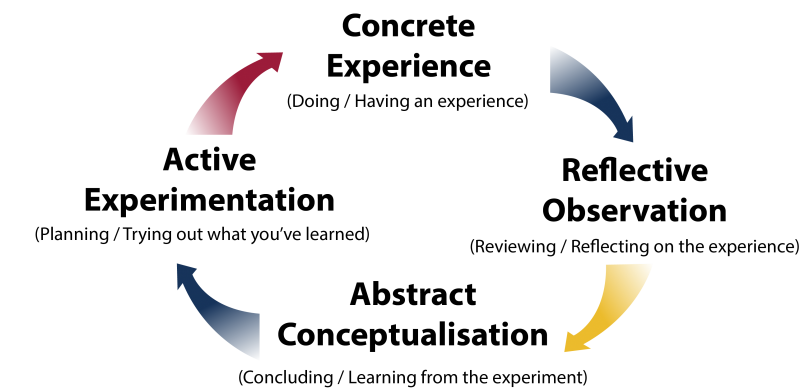
Kolb (1948) regarded learning as more than a brain activity of cognition and perception, learning involves our whole being, how we think, feel, perceive and behave.
Effective learning is seen when a person progresses through the four stages: of (1) having a concrete experience followed by (2) observation of and reflection on that experience which leads to (3) the formation of abstract concepts (analysis) and generalisations (conclusions) which are then (4) used to test a hypothesis in future situations, resulting in new experiences.
Mentoring allows a person to take a step back and have time to reflect. This would enable them to either consider what actions are needed and how to carry them out or stop reacting and instead take time to think and plan based on more information.
In other words, learning through experience should change how we see things and act. A mentor assists in this process.
Lewin believed that individual and organisational ineffectiveness was caused by both inadequate feedback processes and an imbalance between observation and action
Carl Rogers suggests that experiential learning is “self-initiated learning” as people have a natural inclination to learn; and that they learn when they are fully involved in the learning process. Rogers put forward the following insight:
- learning can only be facilitated: we cannot teach another person directly
- learners become more rigid under threat
- significant learning occurs in an environment where threat to the learner is reduced to a minimum
- learning is most likely to occur and to last when it is self-initiated
Often, traditional ways of learning have been less about experience and more about cognition, knowledge is measured by how many facts we have learnt, it can be measured., assessed. However, ideas are not fixed, they are formed and re-formed through experience, traditional training in a classroom can provide the facts/ideas at that moment in time, however it is not providing the learning through experience or providing the on-going feedback process to embed and reflect on the learning. It provides only one stage of the learning cycle, the formation of abstract concepts and generalisations.
How we see the world influences our learning
We all have different views of the world that is informed by our experiences, the culture we live in, the way we were brought up, our values. Mental models determine how we act, they are a powerful influence in what we do. Mentoring enables people to recognise their mental model or mindset and gain new perspectives by helping them to question their assumptions. This is known as double-loop learning (Argyris & Schon, 1996).

Single-loop learning can achieve improvement but doesn’t question how we see things, traditional classroom training can be single loop learning, providing a lack of opportunity to reflect on behaviours and actions, to challenge underlying assumptions in a safe and supportive environment.
Mentoring is a deep way of learning, allowing for open dialogue and reflective practice, providing transformational learning, new insights, perspectives, and ways forward. A good mentor would include how the mentee was feeling, thinking, perceiving, and behaving as part of the learning process.
Supportive Learning and Mentoring
During the pandemic many of us have felt disconnected, isolated, we have missed human connectivity. We are social beings and often we learn best when we are collaborating and connecting with others, we learn from one another. Organisations need to encourage connections between those with existing knowledge, promoting collaboration with peers to improve performance, and on an individual level, supporting and encouraging people to apply their learning.
A supportive learning environment allows time for people to take a pause and encourages thoughtful review and reflection; when people are too busy, stressed by deadlines and schedules, they are less able to diagnose problems and learn from their experiences. Learning needs to take place in a supportive environment that allows employees to apply their learning. Employees need to understand why they are engaging, and the benefits for them individually, as well as for their team and the wider organisation.
Summary
For learning to be transformational, organisations need to encourage continual and collaborative learning, allow people to take responsibility and provide alternative ways of acquiring skills and knowledge to suit their ways of learning. Organisations need to be able to provide people with the space to reflect on their performance, explore assumptions and perceptions that are informing their actions and behaviours; provide feedback, support, time, and opportunity for people to go on and action different ways of doing things.
REFS:
CIPD: Learning and Skills at Work Survey 2021
Office of Learning and Teaching, 2005
How I help..
I support organisations in designing and delivering in-house mentoring programmes and train and supervise mentors. If you would like to discuss how mentoring can support your organisation in developing your people, please contact me on 01332 527144 or enquiries@fptrainingltd.co.uk.
